Commercial fishing boats and workboats demand boarding ladders that can withstand harsh environments, constant moisture, and intensive daily use. Unlike recreational vessels, these boats operate in conditions where equipment is routinely exposed to saltwater, impact loads, vibration, and sudden movement. Heavy-duty boarding ladders serve as a primary access point between the dock and the vessel, and their design must reflect the rugged realities of commercial marine operations.
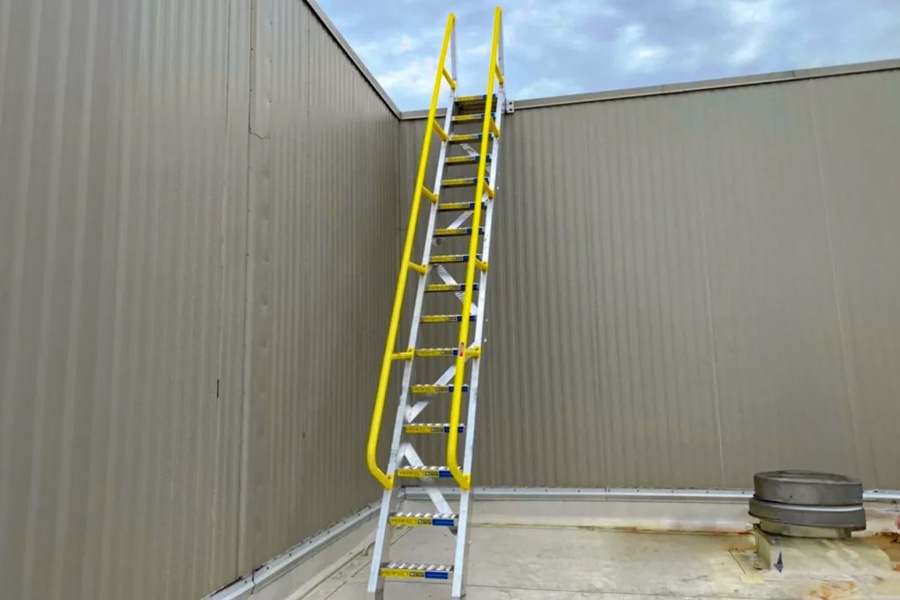
A defining characteristic of custom ships ladders used on fishing boats and workboats is their steep pitch. Space is extremely limited on these vessels, which prioritise working deck area over accommodation or wide access routes. As a result, ladders are typically positioned between 50 and 70 degrees, balancing climbability with compactness. The structure must remain rigid even when the vessel lists or rocks. This places demands on the ladder’s frame, which is usually constructed from welded steel or reinforced aluminium. Steel remains popular for its strength and resistance to deformation under high loads, while aluminium offers a lighter alternative that reduces strain on deck mounting points.
Tread design is another critical engineering focus. Decks on commercial boats are frequently wet, covered with fish, gear, or ice, and ladders must provide dependable traction in these conditions. Serrated bar grating, raised perforated treads, and deeply grooved extrusions are commonly used to ensure grip in all weather. Open risers allow water and debris to pass through, preventing slipperiness and pooling. On many fishing vessels, the treads are designed to accommodate crew wearing bulky boots, ensuring full-foot contact and reducing the risk of slips.
Handrails on heavy-duty boarding ladders play a significant role in crew safety. Given the instability of a working vessel, rails must be sized for a secure grip, often constructed from round or slightly oval tube. Curved or continuous rails are preferred because they guide the ascent naturally and minimise hand repositioning. For boarding ladders that attach from dock to deck, the bottom end may also include reinforced base plates or pivot brackets that compensate for tidal shifts or hull movement.
Durability in marine environments requires more than structural strength alone. Corrosion resistance determines whether a ladder lasts five years or twenty. Steel ladders are often hot-dip galvanised or treated with multi-layer marine epoxy coatings. Aluminium ladders may be anodised or coated with marine-grade powder finishes to prevent pitting. In commercial fleets where downtime is expensive, ease of maintenance becomes a valuable design requirement. Welds, rails, and tread connections must be easily inspected for fatigue or corrosion, enabling fast repairs during short port calls.
In operation, heavy-duty boarding ladders support frequent transitions as crews load gear, process catch, or access different deck levels. Their reliability directly impacts workflow efficiency and crew safety. For boat builders, shipyards, and fleet owners, investing in proper ladder design is not just a regulatory requirement but a practical necessity. A well-engineered ladder ensures smooth vessel access, reduces accident risks, and withstands the relentless conditions that define commercial fishing and workboat environments.